What Is Statixoup?
Statixoup is a reliability monitoring platform that helps businesses keep their websites, APIs, SSL certificates, and scheduled jobs running smoothly. It checks services every 30 seconds, alerts the right people when something breaks, and gathers diagnostic evidence like screenshots and network data to speed up troubleshooting. It's built for developers, DevOps teams, SaaS companies, and ecommerce businesses that can't afford silent downtime.
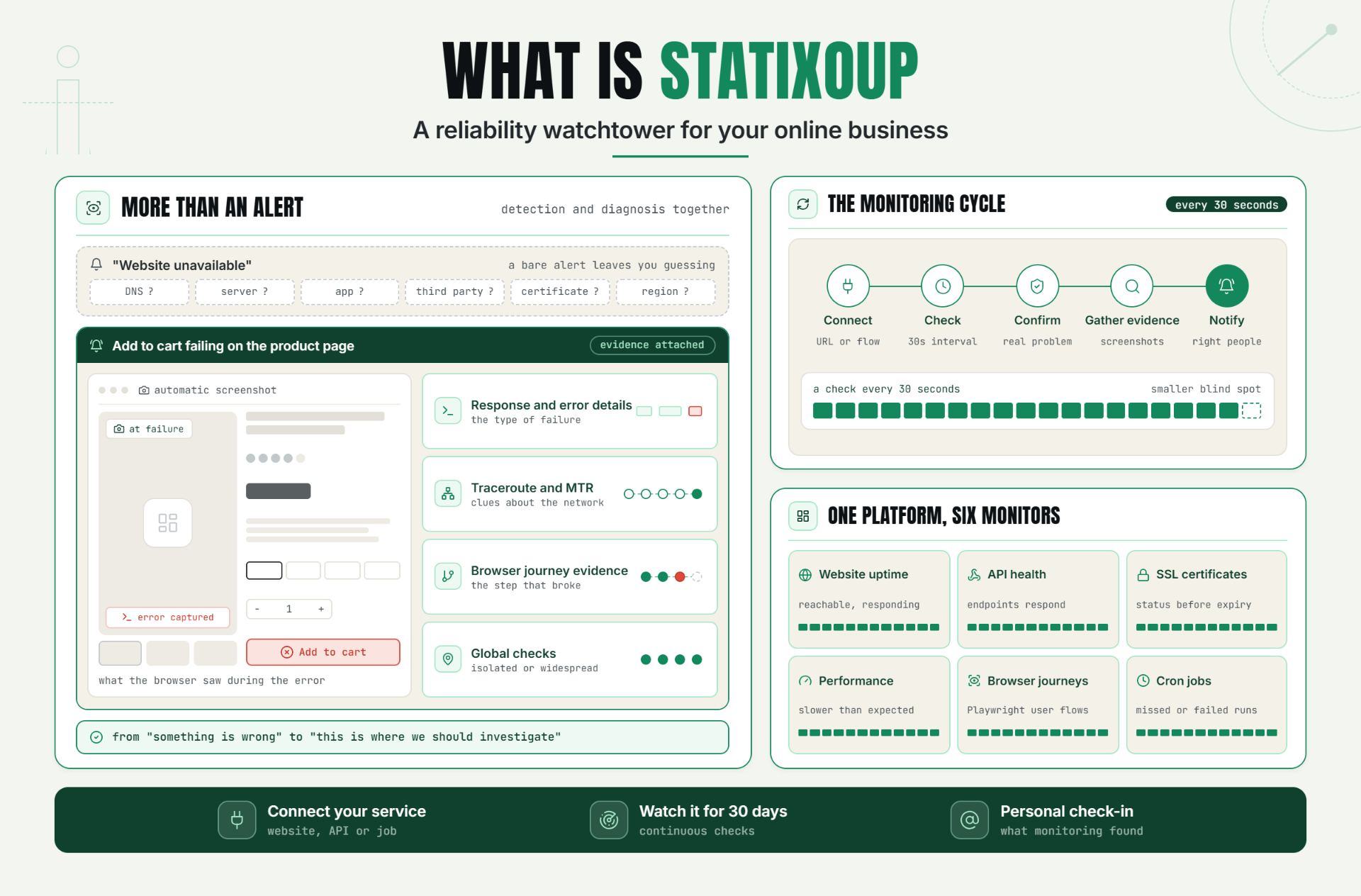
In plain language, Statixoup acts like a reliability watchtower for your online business. It checks the services that matter, looks for signs of trouble, and gives you evidence that helps explain the incident.
This matters because a simple “your website is down” notification is rarely enough. Developers and operations teams also need to know what the service returned, how long it took, what the browser displayed, and whether the issue was isolated or part of a wider failure.
Statixoup is designed to make that context available from the start.
Why website monitoring matters
Downtime does not always arrive as a dramatic, site-wide outage. Many incidents are quieter:
- There is a product page with a “Add to Cart” button which isn’t working.
- The API returns results but with a noticeable delay compared to the normal process.
- The certificate expires after some time.
- The scheduled data backup or sync process stops working.
- The website operates in one geographical area but fails in another.
- There is an error shown by customers that the internal team cannot replicate.
These problems can affect revenue, customer confidence, employee productivity, and brand reputation. They can also consume valuable engineering time when the team has to reconstruct an incident without enough evidence.
Continuous monitoring helps close that gap. Instead of relying on a customer to report a problem, a business can detect abnormal behaviour proactively and begin investigating sooner.
How Statixoup works
Statixoup follows a straightforward monitoring cycle: connect the service, check it continuously, alert the right people when something changes, and provide useful incident data.
1. Connect the service you want to monitor
This is done by connecting either a website, API, SSL certificate, browser journey, or task scheduler. A monitor corresponds to some functionality that is critical for the business.
In case of simple monitoring of a website, this will correspond to the web URL. In case of a more complex process, it can be a login process, search, form submission, etc.
2. Run frequent checks
Statixoup can check monitored services at 30-second intervals. Frequent checks reduce the blind spot between an incident beginning and the team discovering it.
The platform is also designed for global monitoring. This helps reveal issues that may affect visitors in one location even when the service appears normal from another.
3. Confirm that a problem is real
Monitoring becomes noisy when every temporary network delay creates an alarm. Statixoup is positioned around accurate uptime monitoring with fewer false positives, helping teams focus on incidents that deserve attention.
The goal is not to generate more alerts. It is to generate alerts people can trust and act on.
4. Gather diagnostic evidence
Should any checks fail, the Statixoup platform is capable of gathering data that includes response information, automatic screenshots, evidence of errors, and network diagnostics. This will provide the investigator a better starting point.
Instead of asking the question, “Who can reproduce this?”, they can examine what occurred during the failure itself.
5. Notify the team
Once an incident is identified, real-time notifications help the responsible people react quickly. A shorter detection time can lead to a shorter recovery time especially when the alert arrives with enough context to guide the investigation.
What can you monitor with Statixoup?
Statixoup brings several forms of monitoring into one platform.
Website uptime
Website uptime monitoring checks whether a URL is reachable and responding as expected. This is the foundation of most monitoring setups and helps identify outages, server errors, and unexpected responses.
It is useful for marketing websites, online stores, SaaS applications, customer portals, landing pages, and other public-facing services.
API health
Modern applications depend on APIs for payments, authentication, inventory, notifications, and many other functions. An application may appear online while a critical API behind it is failing.
API monitoring helps teams verify that important endpoints respond correctly and within an acceptable time. It can uncover backend failures before they spread through the customer experience.
SSL certificates
The expiry or invalidity of an SSL certificate may raise browser warning signals and instantly erode customer confidence. SSL monitoring assists organizations in managing their certificates’ status to avoid any disruption caused by expiry issues.
This is particularly valuable when a company manages multiple domains, subdomains, environments, or client websites.
Website performance
A page does not need to be completely offline to lose customers. Slow response times can be a serious reliability problem in their own right.
Performance monitoring helps teams notice when a website or API becomes slower than expected. Tracking response behaviour over time can also reveal gradual degradation that might be missed during occasional manual testing.
Browser monitoring with Playwright
A basic uptime check can confirm that a page responds, but it cannot prove that a complete user journey works.
Statixoup uses Playwright-based browser monitoring to test real interactions in a browser. For example, a monitor could check whether a user can sign in, search for an item, complete a form, or move through a checkout flow.
This makes it possible to detect functional problems that exist beyond the server’s basic “online” status.
Scheduled jobs and cron tasks
Many business processes run quietly in the background: backups, report generation, billing routines, imports, exports, and data synchronisation. If one of these scheduled jobs stops running, the failure may go unnoticed until its consequences become visible.
Statixoup can track scheduled jobs and help teams identify missed or failed runs. That turns an otherwise silent failure into an actionable incident.
More than an alert: why diagnostic context matters
One of the strongest ideas behind Statixoup is that detection and diagnosis belong together.
Imagine receiving an alert that says only, “Website unavailable.” You still have to determine whether the problem came from DNS, the server, the application, a third-party service, a certificate, or a regional network issue.
Statixoup is designed to support that investigation with tools such as:
- Automatic screenshots that show what the browser saw during an error
- Response and error details that help identify the type of failure
- Traceroute and MTR diagnostics that provide clues about network behaviour
- Browser-journey evidence for failures inside multi-step workflows
- Frequent and geographically distributed checks for better incident context
This evidence can shorten the path from “something is wrong” to “this is where we should investigate.” It can also make incident reviews more useful because the team has a clearer record of what occurred.
Who is Statixoup for?
Statixoup can support any organisation that relies on websites or online services, but it is especially relevant for:
Developers and engineering teams
Developers need reliable signals and technical context. Screenshots, response data, performance information, and network diagnostics can reduce time spent trying to reproduce intermittent failures.
DevOps and operations teams
The operations team has to keep the services up and running. The centralized monitoring system across various locations, APIs, certificates, and tasks gives them a larger view of the overall situation.
SaaS companies
In a SaaS company, the application is itself the product. Any downtime of the service such as problems in login and payments would directly impact the customer. The browser and API monitoring can take care of areas beyond the home page.
Ecommerce businesses
An online store can technically remain online while its search, cart, checkout, or payment process fails. Monitoring key customer journeys can help an ecommerce team identify revenue-impacting problems sooner.
Agencies and managed-service providers
Teams responsible for multiple client websites need a repeatable way to track availability, certificates, and performance. A single monitoring platform can make that oversight easier to manage.
Founders and growing businesses
Smaller teams may not have someone watching infrastructure around the clock. Automated checks and clear alerts provide essential visibility without requiring constant manual supervision.
What makes Statixoup different?
Many monitoring tools can ping a URL. Statixoup’s value proposition goes further by combining frequent checks with practical troubleshooting evidence and broader monitoring coverage.
Its key advantages include:
- 30-seconds monitoring: More frequent inspections will allow reducing the interval between failure occurrence and its discovery.
- Global checks: Checks conducted at different locations may reveal regional issues.
- Less false positives: Correct alerts will help avoid unnecessary interruptions.
- Automatic evidence collection: Screenshots and diagnostics will provide more data for the team during the event.
- Browser monitoring by Playwright: Teams will be able to test real user scenarios, not only page availability.
- Broad coverage: Websites, APIs, SSL certificates, performance, and scheduled jobs can be monitored as parts of the same reliability strategy.
- Human check-ins: Statixoup’s onboarding approach includes watching the setup and checking in, adding a personal layer to the monitoring experience.
The result is a platform focused not only on knowing that a service failed, but on helping people understand and resolve the problem.
Getting started with Statixoup
The planned Statixoup experience is intentionally simple:
- Connect the website or service you want to monitor.
- Let Statixoup watch it continuously for 30 days.
- Review the results and receive a personal check-in about what the monitoring found.
There is no need to wait for an outage before learning whether your current monitoring is sufficient. A trial period can help reveal response-time changes, certificate risks, intermittent errors, missed jobs, or weaknesses in important browser journeys.
It also gives teams a chance to decide which alerts are genuinely useful before making monitoring part of their everyday workflow.
Final thoughts
So, what is Statixoup?
Statixoup is a reliability monitoring platform that helps businesses watch their websites, APIs, SSL certificates, performance, browser journeys, and scheduled jobs. It combines fast detection with diagnostic evidence so teams can move from alert to investigation with less guesswork.
No monitoring platform can promise that an online service will never experience a problem. What it can do is make those problems visible sooner, provide better context, and help the right people respond faster.
For businesses that depend on being available online, that visibility is not a luxury. It is part of delivering a dependable customer experience.
Ready to see what your current monitoring may be missing? Start your free 30-day Statixoup trial and keep your business online with clearer, faster reliability insights.
Ready to see what your current monitoring may be missing?
Start your free 7-day Statixoup trial and keep your business online with clearer, faster reliability insights.
Follow Statixoup
Enjoyed this post? Follow us for uptime monitoring tips, product updates, and new articles.
Post a Comment

Hardik Vaghani
Hardik Vaghani is a Digital Marketing Professional and SEO Strategist based in Surat, Gujarat, India. He currently works with Ethnic Infotech, contributing to SEO, content marketing, technical SEO, and digital growth strategies. Hardik also creates blog content for Fusion5, focusing on technology, laptops, and consumer electronics. With expertise in SEO, Google Ads, Meta Ads, Local SEO, and Content Strategy, he helps businesses improve online visibility, rankings, and lead generation through data-driven marketing.